
What Are Wildfire Careers?
Wildfire careers include a wide range of roles focused on protecting forests, ecosystems, and communities from wildfire. While some professionals work on the front lines fighting fires, many others support fire management in different ways - before, during, and after a fire.
Explore the variety of types of wildfire careers below. To get a better sense even more jobs that support wildland fire management go to the National Wildfire Coordinating Group’s position catalog.
Types of Careers and Pathways
Firefighting & Field Operations Dispatch & Coordination Fire Prevention & Education Restoration & Recovery
Firefighting and Field Operations
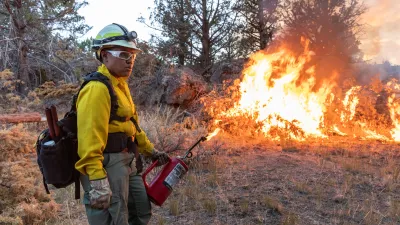
These are the crews most people think of - wildland firefighters who work in challenging conditions to contain and manage fires. Some firefighters focus on responding to emergent fires while others become part of larger crews that work across the country suppressing major wildfires. During the off-season, they assist with fuel management, prescribed burns, training, and equipment maintenance, contributing year-round to wildfire prevention and forest health. Their work is physically demanding and requires teamwork, quick decision-making, and a strong understanding of fire behavior.
Example roles:
- Wildland Firefighter (engine crew, hand crew, or hotshot crew)
- Fire Management Officer
- Smokejumper (parachutes into remote fire areas)
- Helitack Crew Member (works with helicopters for fire response)
- Fire Engine Operator
- Fire Crew Supervisor
We are BLM Fire: Helitack Crews
Dispatch and Coordination
Dispatchers and coordination staff play a key role in emergency response. They track fires, communicate with crews, and coordinate resources.
Example roles:
- Fire Operations Dispatcher
- Incident Communications Technician (manages communications equipment on wildfire incidents)
- Resource Unit Leader (tracks personnel and equipment)
- Situation Unit Leader (analyzes fire data and conditions)
- Airtanker Base Manager (for firefighting aircrafts)
We are BLM Fire: Dispatchers
Fire Prevention and Education
Prevention specialists help reduce wildfire risk by educating the public, managing fuels (like dry vegetation), and planning controlled burns to keep forests healthy.
Example roles:
- Natural Resource Manager
- Fuels Management Technician (reduces hazardous vegetation)
- Prescribed Fire/Burn Boss (leads controlled burns)
- Community Outreach or Education Coordinator
- Fire Ecologist
Defensible space works. When wildfire broke out in Taylor Park, over 100 people evacuated from AEI Base Camp, campsites and homes near Illinois Creek. The fire burned hot, but was stopped at 5 acres. How?
Restoration and Recovery
After a wildfire, forestry professionals step in to restore the landscape. This can include replanting trees, preventing erosion, and helping ecosystems recover over time.
Example roles:
- Restoration Ecologist
- Soil and Water Conservation Specialist
- Wildfire Mitigation Specialist
- Forester
- Supervisory Forester
Forest Service Hydrologist Diane Hopster discusses post fire erosion and the resilient landscape within the Columbia River Gorge in Oregon.
Education, Experience and Training
Step 1: Wildland firefighters must have a High school diploma or GED.
Step 2: Basic Firefighter Training
The first required qualification of a wildland firefighter is completion of a series of classes to learn the fundamentals of fire behavior, incident command, suppression tactics, and safety - labeled S-130/S-190 Basic Firefighter Training (Wildland Fire Training). These courses are offered by places such as Colorado Firecamp or the Colorado Division of Fire Prevention and Control.
Step 3: The Pack Test
The second required qualification of wildland firefighters is that they must pass a medical exam and a work capacity test (a.k.a. “pack test”) to make sure they’re physically able to do the work.
After meeting these requirements, firefighters receive an Incident Qualification Card (a.k.a. “red card”) that serves as the official documentation of their qualifications.
Additional qualifications may include CPR/First Aid Certification or a commercial driver’s license.
Finding a Job
You can find wildfire jobs at a variety of different federal agencies, state institutions, tribes, and private contractors.
Federal Agencies:
Department of the Interior: Bureau of Indian Affairs, Bureau of Land Management, National Park Service, and U.S. Fish and Wildlife Service.
State Agencies:
Local fire departments and fire protection districts
Private wildfire contractors
TIP - Most seasonal jobs are advertised from October to December and are hired between January and March.